PHQ
Patient Health QuestionnaireThe Patient Health Questionnaire (PHQ) is an assessment for screening and diagnosing the most common mental disorders in primary care patients. It is quick and easy to for patients to complete, while representing a well-established diagnostic tool for healthcare professionals to assess mental health issues.
In the 1990s, a research team from Columbia University developed the Primary Care Evaluation of Mental Disorders (PRIME-MD) measure, based on twelve modules assessing different mental health disorders. As a shorter self-report version of PRIME-MD, the research team, in collaboration with the Regenstrief Institute at Indiana University and through the support of an educational grant from Pfizer Inc., created the PHQ and GAD-7 screenings.
Like the original PRIME-MD, the PHQ includes somatoform, mood (PHQ-9), anxiety, eating, and alcohol modules. GAD-7, meanwhile, is a brief, seven-item scale to measure common anxiety symptoms, whereas PHQ-9 screens specifically for depression by scoring each of the nine DSM-IV criteria related to the mood module initially developed for PRIME-MD.
The long-form and short-form PHQ versions allow defined provisional diagnoses for specific DSM-IV disorders. The other PHQ measures are mainly used to provide severity scores:
- PHQ-8 and PHQ-9 for depressive symptom severity
- GAD-7 for anxiety symptom severity
- GAD-7 for anxiety symptom severity
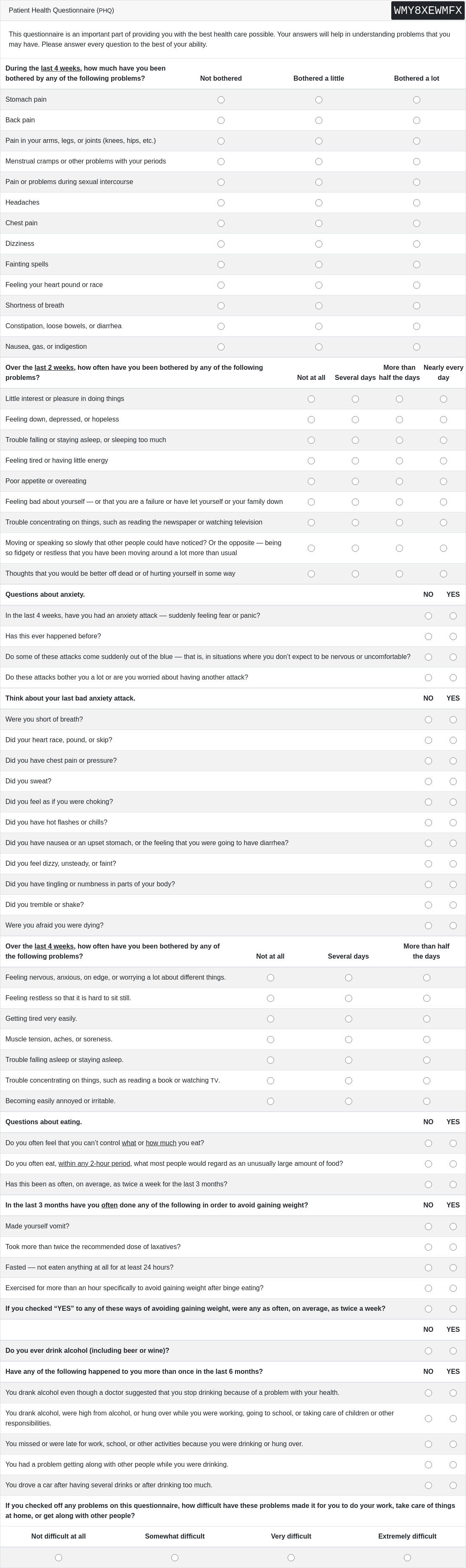
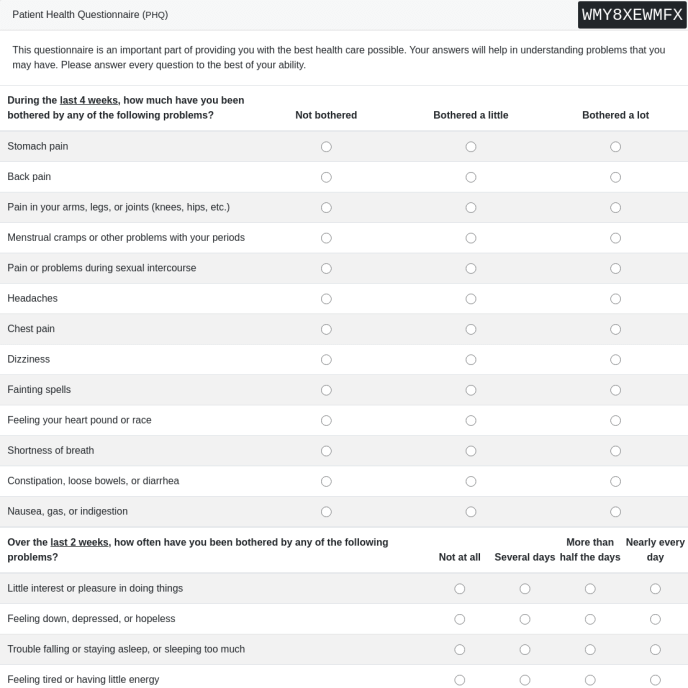
Questionnaire
This is how the PHQ will appear to your patients.
Scoring
In your personal account, you will receive the scoring for the PHQ as shown below or in this screenshot, and it can also be downloaded as a PDF report for your documentation.
The PHQ scoring as PDF for your files:
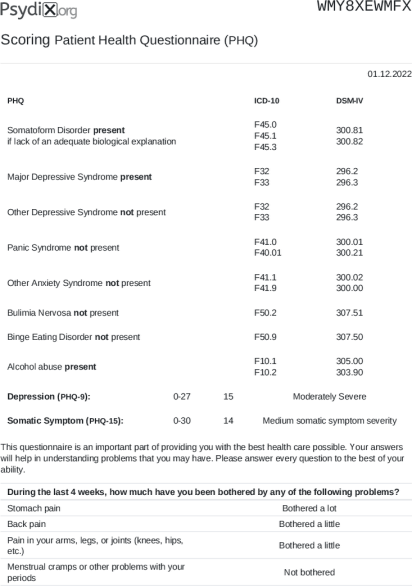
Download a sample PHQ scoring as PDF file.
Interpretation
The severity scores are a particularly useful feature of the PHQ measures, used even more often than provisional diagnoses.
For PHQ-9, GAD-7, and PHQ-15, the range of 5–9 indicates mild symptoms, 10–14 indicates moderate levels, and over 15 indicates a severe level of the respective depressive, anxiety, or somatic symptoms. A score of 10 or higher is considered a yellow flag on each of the three measures, while a cut-score of 15 or higher on any of the three measure instruments is a red flag.
After a provisional diagnosis using PHQ,
some additional clinical considerations may affect care and/or
treatment.
These include:
- Have current symptoms been triggered by psychosocial stressors?
- What is the duration of the current distress and has the patient received any treatment for it?
- To what extent are the patient’s symptoms impairing his or her usual work and activities?
- Is there a history of similar episodes, and were they treated?
- Is there a family history of similar conditions?
You have suggestions for improving this text? Write for PsyDix.org
© Spitzer R. L., Williams, J. B.W., Kroenke, K. and Kollegen, with an educational grant from Pfizer Inc.